Saturday, 31 August 2013

Pedal-positive please

It's so deeply hurtful when you are asked to do something, but there's no real physical support for or willingness to support that activity at all. Of course, I am thinking cycling and the government here. Promotion and encouragement is all we ever got. Gee thanks. Why not do something cycle-positive?

Such as.

Thanks for cycling (Stockholm) handing out goodybags to cyclist. Just imagine, you are stopped and someone says "thank-you for using a bike today". Wouldn't that be great!


Do the right mix (Europe-wide) tackling car-dependence and it not afraid to say so. Something UK initiatives consistently fail to do.


No ridiculous car trips (Malmö) - just watch and be blown away by the simplicity and openness the subject of silly car trips is approached.

In the UK?

We do have people speaking up for cycling. Thanks to Jon Snow and Chris Boardman.


Get Adobe Flash player

But otherwise? Non-car road users get patronised and even blamed by way of info initiatives. Local and national government are not 'afraid' to even do this to our children.

Ghost Street (Newcastle) - award winning, they say. It must also be there fault that they get themselves killed.


Tales of the road (UK-wide) - to scare them into parents cars, seems to be the only solution here.


Nice Way Code (Scotland, please keep it there) - and when they are trying to be funny, you can be sure they get it seriously wrong. Sharing the road but not the risk. Well, think horse, must be the answer surely. Moreover, the bull-crap has been endorsed by CTC and Sustrans too.


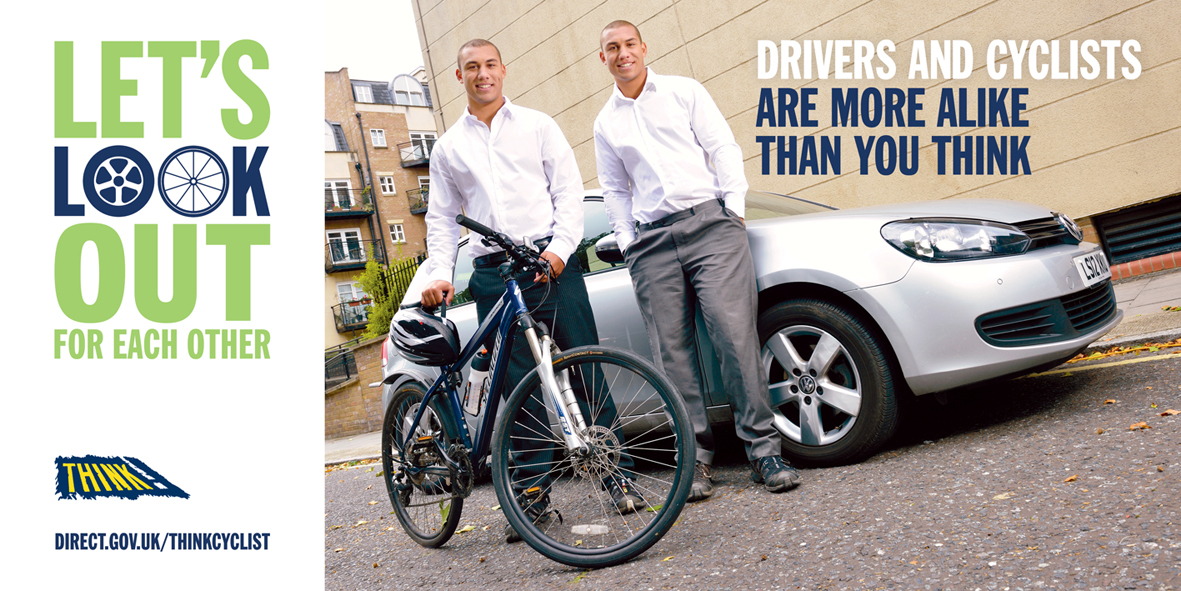
Yes, aw, sure, being told we road users are so alike. DfT's Think! thingy - thinking that lumping together motoring and cycling does the trick. Only one in five drivers has on-road cycling experience.  Anyone listening? Thought not.


It appears as though our authorities can just not imagine life without a car. They are so besotted by it they are unable to tackle the real problem: curbing car use. And speaking proportionately positively about walking and cycling. Proportionate to risks and benefits.


Friday, 30 August 2013

Respect and space

Springfield Road sign

As someone living in the UK who has chosen the bicycle as a main mode of everyday transport, I have to say, I do not at all feel valued on our roads. It's funny. Since we have all these info initiatives and calls to "share the road" and for "mutual respect" and to "be nice to each other" (and see photo above) or whatever they are all called - we should be the friendliest country in the world for drivers sharing with cyclists in perfect harmony.

In "addition", the Highway Code gives useful advice to the driver (which is good as only one in five drivers has road cycling experience) :

147
Be considerate. Be careful of and considerate towards all types of road users, especially those requiring extra care (see Rule 204 below). You should
  • try to be understanding if other road users cause problems; they may be inexperienced or not know the area well
  • be patient; remember that anyone can make a mistake
  • not allow yourself to become agitated or involved if someone is behaving badly on the road. This will only make the situation worse. Pull over, calm down and, when you feel relaxed, continue your journey
  • slow down and hold back if a road user pulls out into your path at a junction. Allow them to get clear. Do not over-react by driving too close behind to intimidate them
  • do not throw anything out of a vehicle, for example, cigarette ends, cans, paper or carrier bags. This can endanger other road users, particularly motorcyclists and cyclists.
152
Residential streets. You should drive slowly and carefully on streets where there are likely to be pedestrians, cyclists and parked cars. In some areas a 20 mph (32 km/h) maximum speed limit may be in force. Look out for
  • vehicles emerging from junctions or driveways
  • vehicles moving off
  • car doors opening
  • pedestrians
  • children running out from between parked cars
  • cyclists and motorcyclists
204
The most vulnerable road users are pedestrians, cyclists, motorcyclists and horse riders. It is particularly important to be aware of children, older and disabled people, and learner and inexperienced drivers and riders.
212
When passing motorcyclists and cyclists, give them plenty of room. If they look over their shoulder it could mean that they intend to pull out, turn right or change direction. Give them time and space to do so.
213
Motorcyclists and cyclists may suddenly need to avoid uneven road surfaces and obstacles such as drain covers or oily, wet or icy patches on the road. Give them plenty of room and pay particular attention to any sudden change of direction they may have to make.

All well then? No. The reality is starkly different. There is a war raging on our roads. Cycling is riddled with risk, conflict and danger, and as a cyclist I find myself taking decisions against the law, simply for my own safety and to make riding for my daily transport bearable, and continue cycling - after all is what government wants to do.

Respect?

There is a hierarchy of harm. Everyone who argues cyclists are bullying and aggressive does not understand how dangerous it feels out there for people on bikes (in fact many don't ride for that reason, and some then cycle on the pavement).

Drivers have to earn respect.

Respect has to be given by the most powerful party first, only then it becomes truly mutual. If only drivers could follow the Highway Code rather than their own self-made Rules of the Road...

Real respect only comes with space fairness

As for myself, I don't want to share - I want my own safe space set aside to reduce the conflict and allow for human error. Only that makes cycling comfortable so that everyone can seriously consider it as a means of transport.

Sharing the road but not the risk - can I please have my own space!


Space for cycling

Monday, 19 August 2013

Newcastle car scrap with jam

Newcastle - vehicle availability

Newcastle gained some good money through the Cycle City Ambition Fund. With their top-up funding it amounts to £20 per head for the next two years (the length of the DfT bid - yes funding certainty would be grand, thanks). Woop woop yay - you should think.

Yet what is the first thing Newcastle do? They scrap a scheme which would have improved cycle safety by re-purposing space away from cars to bicycles. The reason given is the 1960s premise of "car, car and car" - here's what council say:

(a) it was felt that the introduction of these proposals at Welbeck Road would be unsafe due to the narrowness of the road and the volume of motorised vehicles using it (including a large number of buses). It was considered likely that this would lead to potential conflict with other traffic in the road

(b) the expeditious and safe movement of vehicular traffic would, on balance, not be enhanced by the proposed Traffic Regulation Orders.

Because cars matter. Car is king. Motoring into the sunshine, on empty roads. Silly really to support car dependency in a city that hasn't slided down the car-ownership scale too fast and is below the national and regional average for car availability (Census 2011). And where the wards that would benefit from the now-shelved scheme (Walker, Byker, Walkergate) are the unhealthiest in the city (difference in life expectancy up to 12 years to healthy wards, source here) and more households DO NOT even have access to the car.

Newcastle City Council - you are absolutely ridiculous!

Happy motoring!

Traffic Jam (homemade)

Sunday, 21 July 2013

Going Dutch - by helicopter

One of Newcastle's notorious blackspots (no-one walks or cycles there without fear or intimidation) is Blue House Roundabout. It's best to get across by helicopter (which may not quite be the best environmental, or socially or economically feasible, way of travel). On a recent visit the Cycle Embassy of Great Britain was not impressed with the ease of navigation by bicycle at this location.

Yet, Blue House gyratory is on the Gosforth Strategic Cycle Route (now locally known as SCR 4) and the Great North Cycleway (NCN725) where people-friendly designs should be more easily forthcoming. Hello Sustrans, are you going to say something? (City Centre, nudge nudge.)

New plans I have seen look like they have little for cycling 'convenience' where pedallers are probably lumped in with pedestrians once more (just like the latest Central Station plans). Neither does the site fare well for pedestrians with its proposed multiple stage crossings. Be prepared to emerge ten year older when re-surfacing on the other side of this dead space. Hello 1960s! The Grand Age of Motoring is back. And funding has been allocated through the LTP (as also for Haddrick Mill and Cowgate gyratories).

This is terrifying.


But - salvation trumpets - the Dutch are coming to Newcastle, hungry to fill us in on their cycle infrastructure knowledge.  Solutions are there of course. The space is there (of course) - luckily at this location, without starving the Sacred Cow of traffic flow.

Current:
Blue House gyratory - existing

Proposed:

Blue House gyratory - proposed

Overlay:
Blue House gyratory - overlay


Friday, 19 July 2013

Shake off the shackles

Cycling in Newcastle, UK

So many meetings this week; and so many people talking to me again about wanting see car use seriously curbed for a better and safer environment. I think politicians are blinded to evidence and so-called expert advice (highway engineers) - local politicians particularly. (Nationally there might be more evil conspiratory forces at work, with big corps 'stuffing fat cat politicians pockets'. And we all know the more money you've got the unkinder you get... )

In Newcastle access to a car is low - 40% of households do not have one. There are huge health inequalities between neighbouring wards. Public transport can be expensive and cycling is seriously unpleasant, with walking covering effectively a journey distance 1.5 miles before being too slow and restricting your movement radius.

This week I also listened to a talk from a university professor looking at pollution, traffic and climate change modelling (and their interactions) who had come to the only conclusion that curbing the car was the answer, it's driving us in the ground. No, even e-cars are not saving us.

Meeting a mum whose son was killed when cycling, it is still ringing in my ear when she said "I saw the bastard again the other day. He's still out there, driving." When all she wanted him, quite understandably, to be removed from the road. But in our society there is no justice for people travelling by non-car means, she was finding out the hard way. She held back her tears bravely.

Here's Newcastle's public realm story in an other's words:
The 1950s was the last decade of the slow and gradual evolution of Newcastle. At this time the roads and streets were much as they had been laid out in the 19th century and earlier. On them the electric powered trolley bus was still the prime mover of people about the city but it was already being challenged by the motor bus and was to disappear altogether by 1966.

The growth in personal motoring and the unrestricted access to the city centre was as elsewhere beginning to cause problems. The solutions which were to be employed in the 1960 and 1970s were to transform the appearance of much of the city for good or ill.

Source youtube 
And and article in The Times says there is no place for cars in cities.