Saturday, 16 March 2013

Summoned to Cycling

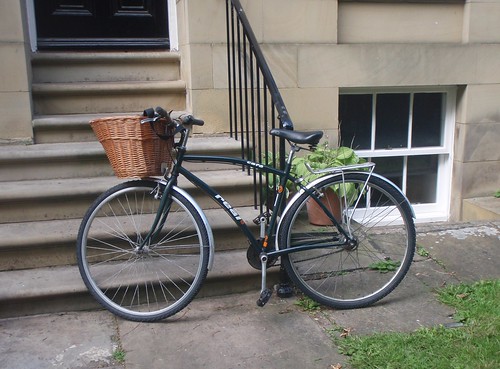
My new bicycle
Workhorse, but so, so slow.


Remember the Summer of Cycling? Ever wondered what became of that initiative? It died. It died the same slow and marginalised quiet painful death that cycling has been condemned to by the UK Government since the rise of the motorcar.

Why folks didn't participate? It solely relied on the strategy of "talking people into cycling" (or as government puts it "encouraging" people to cycle) - yet pedal folks deep down know that cycling really kinda is a niche / specialised activity under the current conditions - something you do not necessarily wish onto anyone else.

I sometimes wonder to myself: "What is it? Why do I cycle...?" And I honestly don't quite know the answer to that. It's possibly complex, and maybe it has something to do with certain kind of attitude and personality
... not minding being different and standing out in a crowd, resistant to aggression and anger from others, fighting spirit, sensing independence and freedom (all in line with Aquarian airy-fairy tendencies)
... a feeling of injustice and discrimination and that it ought to be different (I know it can be, German origin)
... I am not someone to give up easily (hence campaigning for better conditions for cyclists)
It feels like it's got less to do with enjoyment, fun, fitness, health, being green, bla bla.

I do have the feeling that the older I get it'll be less and less likely to continue - unless clear space is made for cycling providing some form of protection and shelter. This would mean I would not have to pedal my heart-and-soul out every time there's a driver behind me nudging my rear mudgards, revving engine, impatient, aggressive, eager to pass to shave a whole three vital seconds off their very important journey to the local corner shop.
It's what's expected of you as a cyclist: you have to look exhausted so the driver knows that you've tried to save them some time.
So maybe ultimately my age comes into the whole (sub-conscious) decision-making process.

Only recently I ditched the nippy hybrid for the heavy workhorse. Better grip on icy roads. Drawback? It's so, so slow. Yet it's probably more akin to a typical cheap Continental bicycle. A bike for the masses (only that the masses don't cycle in the UK). I hoped drivers would understand it's not possible to cycle fast with that kind of bike. So I made the deliberate decision not to go through the tiring demonstration of "pedal my heart-and-soul out" (or I would have died of a heart attack anyways).
As a result drivers were furious that I seemingly did not obey the ritual of exhausting myself to save them some time on their most important journey to the local corner shop.
So... sharing the fast and furious road? The feasibility of this undertaking is a myth - conveniently created and perpetuated by the autolobby who know people are scared back into their cars. Just like the Summer of Cycling predictably withered away in front of our eyes. A maggot-ridden carcass left lying by the road side. Unclaimed. Unreported.

Is it too hilly for clear vision?

So this time - interestingly enough - it was the other way round. The audience was enthusiastic and energetic, buzzing with liveable city ideas, yet the panel could not take it. But not so fast... we'll start at the beginning.

I was at the Newcastle City Council Cabinet meeting which was held as a public meeting in the eminent Great Hall of Northumbria University's Sutherland Building; and 150 or so concerned citizens attended. The focus was "Greening Newcastle" and a briefing paper had been produced in advance. The panel was the Cabinet. That's the stage set. Ready? Go.

Discussion was quickly revolving around cycling and calls for more space for it, and curbing car use and restricting space for it. It was excellent. I felt I didn't need to say a thing. I sat there grinning. Smug even. Very. The experience is typically the other way round - I try to urge, nudge, elbow and shove debate into a better, greener, healthier, cleaner, happier direction.

This wasn't necessary this time.

The only intervening I did was to provide the audience (and the Cabinet?) with the council's own target of 34% of CO2 reduction by 2030 (on 1990 levels) and ask about the how-question and I provided some useful (but the usual) info on journeys, ie too many short journeys are done by car, so there's a massive latent demand for walking and cycling.

We heard from the Cabinet "but Newcastle is hilly"* as an antidote to people getting too excited about cycling in the city. And something about car ownership, which was as relevant as discussing the price of rice in the Antarctic. It did take me a while to figure out what was happening: the Cabinet could simply not comprehend that the Great Hall was actually filled with "early adopters" - the 20% already in favour of Greening Newcastle. In the mind's eye Newcastle was already whizzing with bicycles, city parks and better air, safer streets - a Greening Newcastle had already been turned into a virtually Greened Newcastle and a let's do it! Now! What are we waiting for? Let's learn from other cities (came up numerous times from the floor).

It struck me, that numbers (statistics, data, figures) have become irrelevant in a society so used to spin, emotive and emotional bargaining and pseudo negotiations, con-consultations and foregone conclusion. A society that's lost faith in politics and politicians, disengaged and mistrusting. Yet the question posed by the Cabinet was how the City Council can engage with the city, its residents and businesses.

Here's the answer. It could not be more simple.

By providing leadership and allowing ample space and time for public debate. The latter sort of happened the former didn't this time.

For any debate to be informed however the experts (engineers, researchers and scientists) must be involved. It's these people society still trusts and they can be the objective observers and contributors from the independent sidelines of the debate.

But the policies, the direction, the vision will have to be set by the Councillors. That's your job. Be brave! And for Newcastle's sake get on with it! People are waiting.

* Note to self: we'll invite Cllr Nick Forbes and his merry Cabinet to another City Chief Cycle Challenge methinks.

Sunday, 3 March 2013

Beefing up the Budget

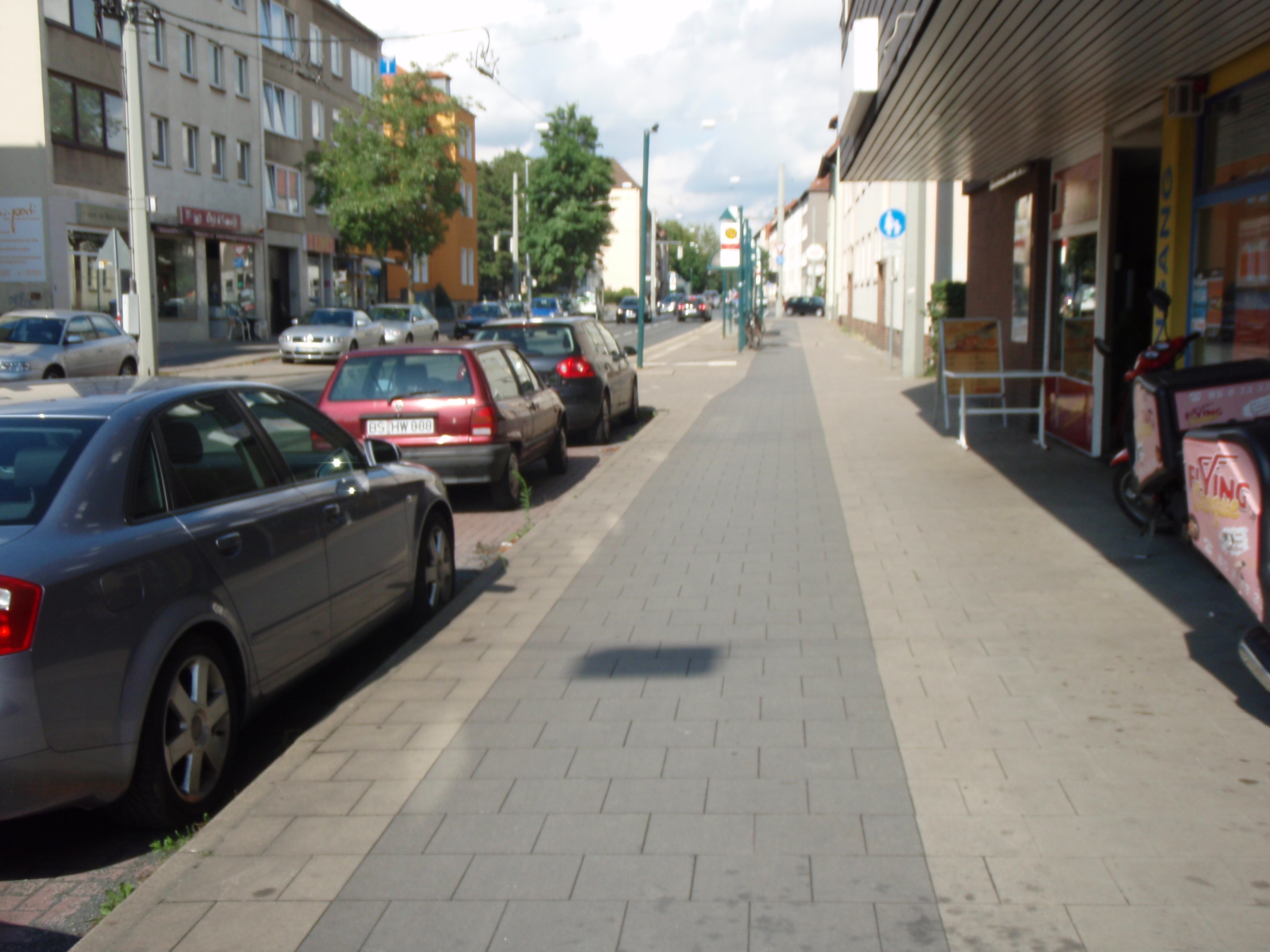
Continuous
Cycleways - it can be done - even providing continuity at a tram station

I had it again the other day "but.. it's so... so... complex!" and "oh, it can't be done". The doubters, you find them everywhere. Why people keep saying it's complex and it cannot happen when it comes to cycle infrastrcuture - I don't understand.

It could not be more simple.

Also... you may ask, why does she keep going on about cycling infrastructure so much?
  • Yes, it is either negligently missing or criminally inadequate in the UK. I think we all agree.
  • But first and foremost of all - that transition will cost money and the other measure will be relatively cheaper to achieve. 
And whilst it's a proven investment (as opposed to a subsidy, ie the initial expenditure will be recouped through the benefits over time) - money is coming through a totally inadequate drip-feed mechanism at the moment.

This start-stop nature stifles local authorities to include cycling in long-term planning. Subliminally, the political leaders, chief executives and director are told that providing for cycling isn't worth doing. And council officers are constantly busy bidding for money for something they may not even have the design know-how for or interest in, or a clear mandate from their superiors. Cycle campaigners and (council) engineers alike ought to clamour for a budget to transform our cities, roads and streets. (And engineers - through their professional institutions and through their superiors at their workplace - should clamour for relevant CPD-accredited know-how courses to be set up and to attend those.)

And relentlessly so, until a long-term national budget dedicated to capital spending for cycling infrastructure is set at £1bn per annum, year on year (European investment levels).
  • cycle campaigners, because they are the voice for future cyclists and liveable cities and they can work with the decision-makers, politicians and local councillors to get this into the agenda
  • council engineers, because currently their authority is negligent in providing adequately for liveable cities and (future) cyclists and this has to be flagged up to the decision-makers, directors and local councillors
So back to infra. This is how simple it is.
  • all 30mph + roads to be fitted with cycle-specific provision (or reduce speed, but be design please) - various separation methods are listed here (this will cost lots and yield results!)
  • other roads to be assessed for cycle provision needs, but are these are more likely to be dealt with through traffic calming: 20mph conversions, filtered permeability methods etc (this will cost relatively much less!)
The space is there. Proof in point is Amsterdam: it's got tiny streets and THEREFORE they had to do something about them. And they did. Proving that even in small space you can fit in cycleways. Mind you, it is often used to "prove" the opposite: BECAUSE they have so little space... it can only EXCLUSIVELY work there.
  • Nope, Amsterdam didn't grow organically into a cycle city. It was political decisions and setting the right policies that got them there.
  • Yes, they had to do start thinking about this earlier - as space ran out earlier.
So. The engineering side is most simple. Maybe by complex they mean the decision to take space from drivers, driving or parking, was, eh... difficult? Certainly not complex... unless you look at the bureaucracy machine...

What's complex is finding the right people to make these simple decisions. Seeing through the local authorities rainforest jungle of trees is complex. Finding the someone who can be held to account is complex. In that case, I'd not say complex were the right word then. It's more political, maybe.

Just watch this (from Copenhagen with love) http://www.youtube.com/watch?v=ibCcp0Y3OB0#t=04m31s

Saturday, 2 March 2013

Et tu, Brute?

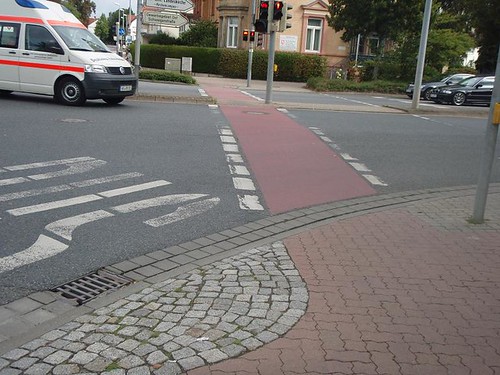
Intuitive paving design
Is this cycle path dangerous?


Remember the Dutch (Copenhagen) study I checked over last week? This week, I had a look at a German study about cycle infrastructure and safety. Headline is "Studie belegt steigende Unfallzahlen durch Radwege" and is quite attention-grabbing, possibly translating it to "Study proves increased accidents caused by cycle paths" gives you the flavour.

It appears to be a before-after comparison study somewhere (!) in Germany, published in 1991 looking at absolute totals only. I'd have thought given its advanced age, it would be dubious practice to use it to inform policy, yet it was quoted to me in support of "cycleways are dangerous" - so here it goes.

Really, it would be good to see the original study, in the absence of that, I make the following comments about the very limited data available. If anyone has the original I am happy to look at it.
  • the number of users is not stated. Imagine cycling had increased (as it can be expected when cycle infrastructure is offered up), then the collision data should be presented in relative terms to that increase, ie would be relatively lower.
  • the collision types are not categorised. This means that - dramatically put - loads of minor collisions (cuts and bruises) would count the same as a fatality. Without that distinction it's unequal accounting.
  • It investigates cycle paths running parallel to the road/highway but we do not know further details on the paths themselves or the junction design. As we all know you really have to look at it in detail, even down to design dimensions, corner radii, road markings etc. Missing that info makes it more difficult to comment. [We are all be experts in the UK! Experts on what crap cycling infra really really looks like. And feels like. Aaargh.]
The first two bullet points in the above list would have certainly been the next logical steps if a full (more meaningful) analysis were carried out. In the absence of that data, or even the study text, I - for one - remain convinced that cycleways are safe.

It's worrying that the website states that "this study unambiguously [eindeutig] proves that cycle paths have higher collisions rates compared to bike traffic on the road". This statement is clearly dramatising and polarising the debate unnecessarily, forgetting the wider view on the data and circumstances.

The title of my blogpost?

Well, the study is quoted on the adfc (German ctc) website - albeit a local branch of theirs - which makes me feel a tiny tad uneasy about their motives. I'd strongly advise the adfc branch to revise the webpage and tone it down, and possibly advise the national adfc to check up on the branches shenanigans.

Saturday, 23 February 2013

In absolute terms - I love Copenhagen

"Bicycle Tracks and Lanes: a Before-After Study"by Søren Underlien Jensen, Paper, January 2008 on first sight is saying that cycle tracks and lanes are unsafe. But is it? I - intrigued - had a look at the paper.

Let's have a look at absolute numbers first. As with any study, that's the raw data to you and I. Absolute numbers are the totally unmitigated figures, not adjusted for context of traffic volume or distance travelled. Using absolute numbers without considering the surrounding circumstances can lead to hilarities like this one. Remember this? Once upon a time there was Norman Baker who had a 'cycle' chum Mike Penning who proudly pronounced that "The Netherlands could learn from UK on cycle safety" covered by bikebiz, roadcc and guardian.

Little Mikey was looking at total cycle deaths (UK 100 vs NL 300) rather than contextualising it with the number of people on bikes and/or the distance cycled. This silly man was actually saying "Cycling in the UK is safe (there aren't any cyclists)" or "UK is a very safe country for bear attacks and mosquito bites".

Absolute figures are important for before-after comparisons as total collisions numbers may actually go up due to increase in ridership and journeys.

Anyways, back to Denmark.

So.

The absolute figures from Jensen study are as follows ref. Tables 3


Observed Observed

Category BEFORE AFTER Reduction
Crash All 2,987 2,911 3%
Injury 1,313 875 33%
Property damage only 1,674 2,036 -22%
Injury All 1,476 937 37%
Fatal 25 22 12%
Severe 757 665 12%
Minor 694 250 64%


Observed Observed

Category BEFORE AFTER Reduction
Intersection All crashes 2,010 2,171 -8%
All injury 938 636 32%
Links All crashes 977 740 24%
All injury 538 301 44%


Observed Observed

Category BEFORE AFTER Reduction
Pedestrians, all injuries Total 469 315 33%
At intersections 267 197 26%
At links 202 118 42%
Bicyclists and moped riders, all injuries Total 574 406 29%
At intersections 353 285 19%
At links 221 121 45%
Motorists, all injuries Total 433 216 50%
At intersections 318 154 52%
At links 115 62 46%


The numbers of slight concern would be the negative reductions (ie increases) in the right-hand column. I say 'slight' because injuries are down and only property got damaged. Now... this is where we should not forget that these absolute terms haven't even been adjusted for the increase in cycling which was a respectable
  • "20% increase in bicycle & moped traffic and a 10% decrease in motor traffic" on tracks
  • "5% increase in bicycle & moped traffic and a 1% decrease in motor traffic" on lanes
So how is this study used to "prove" cycle infrastructure is dangerous? Well. The Jensen study tested a prediction model (these fancy algorithms listed on early pages in the study) which already factored in a reduction in collisions. And the prediction model predicted lower reductions than were achieved in reality. That's it.

My advice, be skeptical when someone quotes yet another study that "proves" that cycle facilities are dangerous. First look at totals, then check whether adjustments for increase in bike traffic, distinction between collision or injury categories (such as fatalities, major, minor, near-hits) have been made.

And yes, it's important to get the design of cycle tracks and lanes right too. Remember: existence of real cycleways in the UK is few and far between. What the Jensen study is talking about are proper pedal routes, not the substandard sh*te that cyclists - condemned to second-class citizenship by the UK authorities - get here.

Sunday, 17 February 2013

Civil cycling courage for cycle paths

It's amazing. I have been in Braunschweig, Germany, my hometown for four days. And after several daily miles on my bike, I've had no beef with peeps in cars. Why? How is that even possible? The starkest difference to the UK is space division: most notable cycle paths on every busy road. And not just because the space was there (WW2 - don't mention the war). Pro-bike planning decisions were actively taken, decades ago.

In the UK the nature vs nurture debate would start here. Why a meagre 2% of all journeys are made by bike in the UK? I believe the answer entirely lies in nature... the nature of our roads, the way the space is divvied up and carefully designed. People react to their surroundings, and get (subliminal) messages of what the coded practice is. It is NOT a cultural thing, it's a inherently human thing.

In my hometown, space is so much clearer to read. It's inevitable. You feel you must use it. And others do, so you "follow".

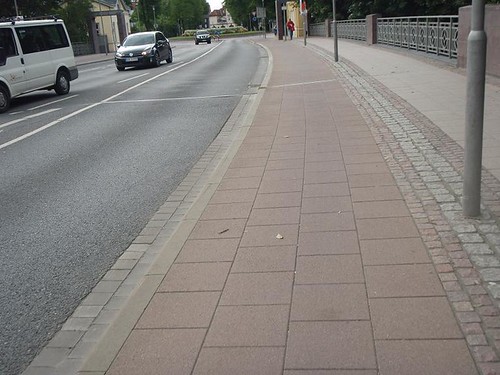
Cycle path
Wolfenbüttel - typical cycle path, grade-separated

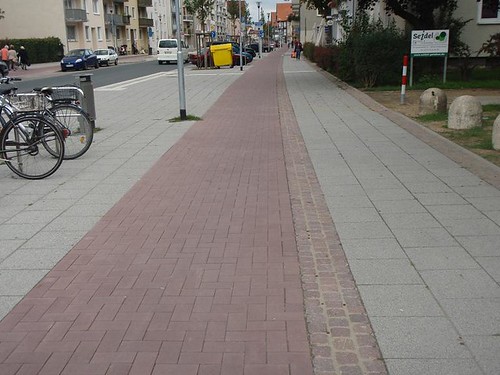
Cycle path
Wolfenbüttel - cycle path on high street

Besides the cycle paths on busy roads, as above examples for Wolfenbüttel (home of Jägermeister), my hometown's one-way streets are fitted with cycle-contraflows. Neighbourhoods are just that: places for people and you know it: parking space is broken up by trees and green build-outs, not every inch is eeked out for car parking akin to a boring and predictable production line in a factory. There are still plenty of cars (of course, Autostadt Braunschweig is nearly "owned" by Volkswagen). But the machine has been tamed by providing space for other ways of getting around too. It is a car city, not afraid of transport diversity. There are Fahrrad-Straßen too. And their network is expanding year on year.

But there are no cyclists in the UK! So transition is the key question.

You don't want to be the odd one out, you do as others do. Herd instinct. Again, people react to the surroundings. Who are we building these "new-fangled and innovative" paths for? It's people not yet currently cycling. People who now say "Too much traffic, too aggressive, there is no space for cycling". Because there's another difference: in my hometown granny and grandad cycle; kids bike to school together; and so many more women use the bicycle here for transport. People feel safe. You see very few helmets, an indicator for the little worry people have about their personal safety.

Elephant's feet
Grandad taking kiddo for a ride

So. Others have done it before. Cycle paths on busy roads opens up cycling to the whole population. I estimate it's a maximum of 30% of roads that are accompanied by cycle paths in my hometown. The others are dealt with by traffic calming and informal 'community enforcement' - where people live and play and they will feel a sense of belonging towards their street. Cycle paths in combination with bike-friendly junctions is important, as these follow the main arteries and primary routes, they are direct and don't send you 'round the houses.

The driver-turning-left concern. I can report there are no problems apart from that by its sheer nature it is a conflict point. Every junction is a danger spot, as routes are crossing. Again, it's clearly in the design. Corner build-outs for slower turning speeds, a clearly marked cycle path across the sidestreet and possibly combined with a speed bump. And I won't lecture you on appropriate junction design and traffic light phasing.

Some civil cycling courage is needed for the transition in the UK.

Fast cyclists (a minority in a cycling country, probably a majorty in the UK) may like to stick to the road. So listen up, CTC. One thing that Germany did get wrong was the "Radwegebenutzungspflicht". Let's learn from that too and not repeat it here. This is not to say cycle paths aren't required for the not-so-super-fast cyclist (ie the majority in a cycling country).

So, how are we hatching this chicken's egg in the UK? And don't say it's too wet for chicks.

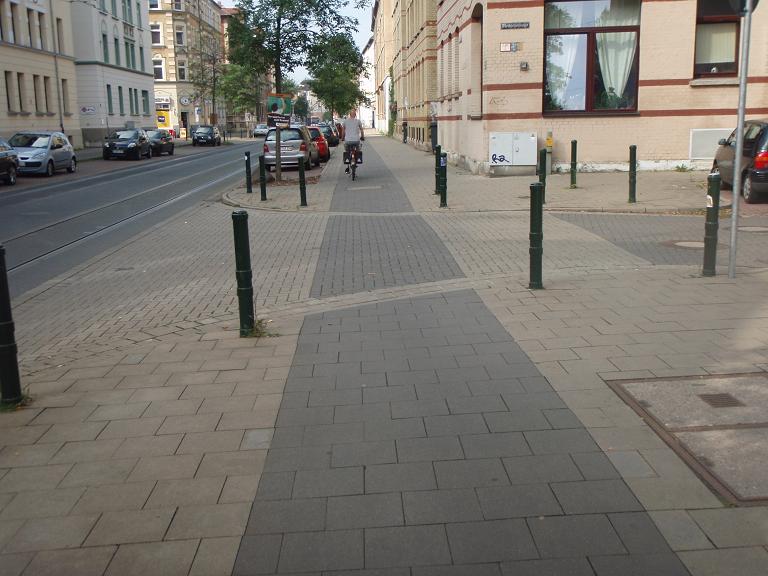
Intuitive paving design
Braunschweig - side street with clearly marked cycle path

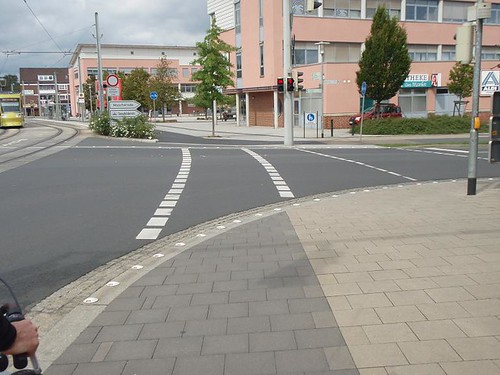
Elephant's feet
Braunschweig - crossing with clearly marked cycle path (elephant's feet)

Elephant's feet and colour marking
Wolfenbüttel - crossing with clearly marked cycle path

Saturday, 9 February 2013

It's YOUR problem... you are lazy.

I wrote this thing here How many UK drivers cycle? a little while back, concluding "not many" (also read the comments if you can). Recent reading (The Way Ahead - Cycling Europe [pdf] pointing me towards Cycling Motorists 1992 [googledocs] << thanks @srobalino) prompted me to think again. The let's-be-friends argument was also repeated again by the AA President in the on-going Parliamentary Inquiry by the APPCG:

“Drivers and cyclists are the same people.  We need to break down barriers – change will come mainly from changing perceptions.”

Aw!

But. Really? Is it true? Is it helpful?

It's of course a con. It's playing this old scratched and screeching record of the "behavioural change will sort it all" debate akin to "safety in numbers" without explaining how higher cycle modal share could be achieve and thereby ignoring to address the reasons for people not cycling.

Alarm bells.

It's a complete and utter distraction to what's required. By effectively saying "It's your problem", it becomes another victim blaming approach - so well-known to cycle folks. And then promotion campaigns, such as smarter choices, are readily funded - like handing peanuts to monkeys, you know, altruistically.

It is The Energy Glut that makes it abundantly clear that what we are facing is a politico-environmental and not a lifestyle problem ie road space adjustment will trigger behavioural change. And that our politics are heavily influenced by bully lobbies of heavy industry oil, car, roads and petrol.

I remain convinced that AA knows all this. They know nowt will happen, since transport behavioural change - without the design changes to our roads - will remain elusive as ever. And furthermore, AA's own figures bear it out: we are not the same people:

So, back to the Cycling Motorist, referenced above. We are looking for evidence of regular on-road cycling. In 1992, 1 in 5 (18.9%) drivers were also partaking in utility cycling. Interestingly it states "The provision of more cycle lanes and paths may encourage greater use of the bicycle". And further "Things that might encourage cyclists to cycle more" highest ranking at 23% was "cycle lanes/paths" followed by "Better weather 13%, Less traffic 10%, For exercise/health reasons 6%, Better bike 5%, Loss of car 4%, More time 4%, Secure place to leave bikes 2%".

And then in 2002 the figure was, eh, 1 in 5 (20.6%).

It could euphemistically be called an increase. Still too few "Cycling Motorists" to make a tangible difference on our roads for cyclists.

So let's go for the next best thing which evidently is more "cycle lanes/paths".

Thanks goes to AA President for supplying Cycling Motorists 2002. Let's go one step further and speak openly about its findings. These effectively mean publically talking about road space re-allocation to bump up the modal diversity scale. And stop taking the easy-way-out: the behavioural change diversion.


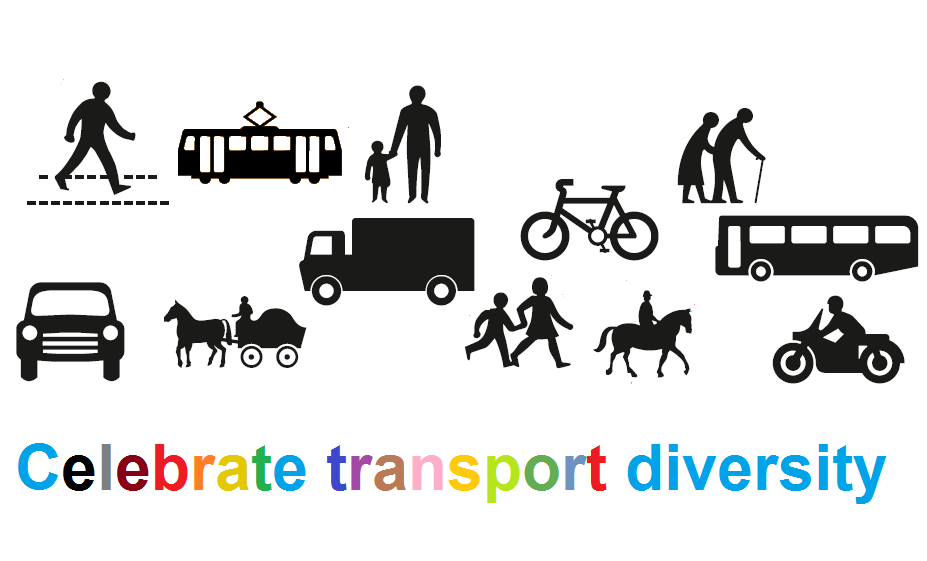
Transport Diversity